我有兩個願望。
第一,三、四十年前到各山部落,都聽到小孩子說族語。後來因為電視的入侵,孩童只好在學校上族語課。希望將來隨便到哪一個部落,聽到小孩子說的是族語。
第二,臺灣以前到處都有鹿。希望在我有生之年,在臺灣的山林看到野生鹿群還不覺得稀奇。
by Sabiy Yugan
W是我多年好友,只小我一歲,是我見過少數相當勤儉樸實的年輕人之一。這年頭工作不好找,W一方面向無數個投資顧問或證卷金融公司投遞履歷,另方面不斷補充實力、報考相關專業證照,現在他已拿了兩個,並準備進取分析師認證。
目前人窮,志不窮的W,省下每一塊錢,皮鞋見底了都捨不得買新的,有時我笑他是鐵公雞。多年來他密切關注臺灣與國際經濟走勢,培養自己股市觀察與分析的能力;世界角落發生的大小事情,只要會影響臺灣與世界經濟情勢的,逃不出他的眼睛。
日前與他聊天,家裡沒有電視、也不常看新聞的我問到選舉的影響…… 他一口氣說了幾分鐘,真的將局勢歸納、分析得很清楚,可惜我記憶力不好,佩服之餘卻也無法將句句箴言記起來。只記得他提到中國大陸現已限制陸客來臺觀光,端看何方當選決定下一步;而臺灣經濟與國際關係仰賴的不是美國、日本或歐洲等其他國家(他們皆已自顧不暇),是中國大陸。
他告訴我,總歸一句:「寧投廢票,也不要因為不喜歡馬英九而笨到把票投給蔡英文。」聽著剛毅木訥,將青春都投注在臺灣經濟(當然還有自己的經濟)上的他搖頭嘆氣,心中實在有種莫名的哀傷。
後來他還寄給我一封e-mail,只寫了以下這一段「蔡英文缺口」:兩岸貿易估算,100年1-9月台灣對大陸貿易佔我外貿總額比重23.0%;其中,出口佔我總出口比重29.8%,進口佔我總進口比重15.6%,如果加計香港部分,我對大陸及香港貿易佔我外貿總額比重為28.9%,出口佔我總出口比重為40.6%,進口佔我總進口比重為16.2%。
說實在的,我不懂數字,但無奈現在全球化的工商社會,沒有數字交不到「國際朋友」~~ 交朋友都來不及了,還樹立敵人嗎? ~~除非像亞馬遜河流域的原住民皮拉哈族人,幾乎不受外來社會與現代意識的入侵,連數字的概念都沒有,也不學!{請看【別睡,這裡有蛇!】很好看的書!}
我親愛的臺灣,好不容易看到原住民的聲音漸起、族群意識漸明,各族群的交流好似要更加活絡起來,好不容易有個雖然許多事情還沒做好,但至少可讓國際關係穩固的總統;實在不希望因為那麼快地又想「換人做做看」(其實我感覺這句話很簡單卻很不單純、很不負責任),造成國際地位的飄浮、動盪,直接影響臺灣經濟,使追求安居樂業的基本機會都葬送了。臺灣很強,但是也很脆弱,安內攘外應該要並重;我們可能經不起下個八年、十年的經濟萎靡,國庫空空。我也想要有許多改變,但有經濟的基本穩定,才有機會談更多、更廣、更遠的理想與政策。

 A beautiful, if somewhat torpid, qimbahu / 龜殼花/ pointed-scaled pit viper / protobothrops mucrosquamatus. Notice how tightly it is holding to the propane bottle with its tail. I prodded it off its perch with a bamboo pole, and it held on like an acrobat with its tail. Finally, I persuaded it to find some other place to spend the night.


今早很興奮!看到線條分明的影子!雖然還下細細的雨,但是可以看出太陽在一片稍薄的雲後。
下午沒下雨。突然,Sabiy叫,「有陽光的樣子!」雖然看不到太陽,但有巴掌大一塊天有點灰籃色。
入夜看到獵人座,好久好久沒看到星星。
住雨林的樂趣如斯。
We had some real excitement this morning: clearly defined shadows! It was still raining, but some sunlight made its way through the clouds.
By afternoon, it had stopped raining, and by nightfall, we could see Orion, the first stars we have seen for weeks.
Such are the joys of living in the jungle.
今年不缺水。

前不久本blog提到日本軍閥不允許達彥織布-(點)-。這項古老手藝幾乎斷絕了,連傳統布也很少留傳下來。當年高金素梅要競選立委時,她想著達彥衣服,但只能找到一塊舊被單布。只好披了被單布上電視。播出時,部落的雅姬(阿嬤)看到,達拉蓋,穿被單布上電視,急叫家人,「快!趕快把電視關掉!」~~她以為如果關電視,大家就看不到。
Recently on this blog -(here)- I mentioned that, during the Occupation, the Japanese banned Tayal weaving. The art was almost lost, and few pieces of authentic weaving survived. When Ciwas Ali, a Tayal, first ran for the Legislature, she wanted to wear Tayal clothing, but the only traditional woven piece she could find was an old bed sheet, so she fixed that up and wore it.
When she appeared on television, a yaki (grandmother) was shocked and told her family, "Quick, turn off the television!" She thought that if the television was turned off, nobody would be able to see the mortifying scene.
Recently we went to a talk by the Tayal poet Walis Nokan / 瓦歷斯‧諾幹. One of the many noteworthy parts of the talk was that he mentioned that the Tayal tribe has also been called the Atayal. Walis stumbled on the pronunciation; it is obviously an unfamiliar word. The reason this is noteworthy is that, in my decades of experience with the Tayal, this is only the second time I have actually heard a member of the tribe say "Atayal," but this is the name by which outsiders call the tribe.
The only other time I have heard an aborigine use the name Atayal was about ten years ago, when I asked someone if she had ever heard the name, and she said yes, she recalled hearing someone say Atayal, but she forgot who. But she was a Sediq; in those days Sediq were still considered Tayal, but have since split away.
I have asked many Tayal about this other name, and many have never even heard of the name Atayal ~~ I guess they should pay more attention to what the learned authorities have to say!
Due to the mysterious workings of official orthography, "Tayal" is actually pronounced dah-YEN, so now some people prefer to use Dayan, so we don't sound like bathroom tiles or something. For that matter, I suggest 達彥 for 泰雅.
今晚準備煮晚餐,我先到後門看小狗吃完了沒有。一推開門,有個東西掉扗我頭上、脖子上;往後縮,一條小蛇掉扗地上、、扗門裏面。身長只有六十公分左右,不粗,看樣子像龜殼花,可是還看不清楚,牠就鑽到洗衣機後面。阿超來幫忙看:當然,就在此時發現大手電筒壞了,可是有兩枝小的可以用。無奈,那位小朋友就是不出來。只好請消防隊來幫忙。兩位消防員來,穿著厚重高筒鞋,帶著夾子。洗衣機、烘乾機推開,蛇扗牆邊。消防員動作很快,立即夾住了,放進籠子裏去了。感謝!
住山上真好。昨晚有蝙蝠飛進來,開了窗請牠飛出去。今晚來蛇;蛇是智慧的化身。福慧雙來!
This evening before we started to cook dinner, I went to the back door to see if the dogs had finished their meal. When I opened the door, something fell on my head and right shoulder. I pulled back, and a little snake fell onto the floor::: inside the door. It wasn’t very long, only about two feet. It looked like a qimbahu, one of our poisonous neighbors, but I couldn’t tell for sure. It slipped in back of the washing machine, and I couldn’t get it out, so we had to call the fire department to help.
Two firemen came, wearing heavy, high boots, carrying a snake snatcher. They moved the washing machine and dryer out of the way, spotted the snake, and quick as a cricket, snatched the snake and put it in a cage. Many thanks!
I just love living in the mountains!

日本人禁止達彥(泰雅)織布,也禁止種傳統的紅苧麻,強迫改種和服用的白苧麻;但白苧麻不適合達彥的織法。戰後,傳統織法幾乎斷絕了。
六十年代,霧社一帶的賽德
二十年前,苗栗達彥少年尤瑪‧達陸下定決心復興固有文化,向耆老學織布。要織布,需要紅苧麻,但早已沒有人種。找了很久,終于扗新竹一處達彥部落找到了,一位八十七歲的雅姬(阿媽)不忍心讓紅苧麻消失,一年復一年種。尤瑪與其夫弗耐‧瓦旦來向她要,雅姬說,「等妳很久了」。紅苧麻給尤瑪,但條件是,一定要種,一定要傳!
尤瑪勤勉學習,現扗已成為世界級織布師,竝扗家鄉開了『野桐工坊』>>點<<發揮祖先的瑰寶,且傳給部落的婦女。
有的故事還是快樂的結局。
During the Japanese Occupation of Taiwan, the Japanese outlawed traditional Tayal weaving, because it was the qualification for getting a facial tattoo. When a young woman could weave cloth, she could get her face tattooed, and only then was she eligible to marry.
Not only did the Japanese outlaw weaving, but they also forbade the growing of nuka 紅苧麻 the ramie used in weaving. Instead, they forced the Tayal to grow 白苧麻 the kind of ramie used in making kimonos, but useless for Tayal weaving. (Tayal weaving was outlawed in about 1920; the Japanese Occupation ended in 1945, with WWII.)
In the 1970s, it was popular for Sediq (a closely related tribe) girls to weave mufflers for their boyfriends, the longer the better. I recall seeing weavers in Snuwil seated on the ground, weaving in the most traditional manner.
In the 1990s, Yuma Taru, a young Tayal from Miaoli, was determined to resurrect the ancient skill of weaving while there was still time. She learned how to weave from her yaki (grandmother), but they needed proper filament; also, her yaki wanted to teach her how to make the cord from nuka. With her husband, Baunay Watan, they set out in search of proper Tayal nuka.
After a long search, they finally found a patch cultivated by an 87 year old Tayal yaki (grandmother). Yaki told
Some stories have happy endings.

We were perplexed and cautious, but curious. After some more growling, dodging, and feinting, Yumin suddenly darted his head down,
and

came up
with a doggie treat in his mouth.
The doggie treat I had given to Tlahuy an hour or so before. Apparently it had fallen down behind the logs and Tlahuy gave up on trying to fish it out. So Beagle Yumin nabbed it.
前一陣子到南部一所私立大學。校園設計很用心,建築舒適,空間利用的很好。每一棟有電梯,進電梯就有海報,也有螢幕;播放的DJ該有的都有:倒戴棒球帽、墨鏡等等各種顯示自己獨特個性的標準配備都有,cool到不行。海報宣佈電玩比賽、卡啦OK比賽。
整個學校給我的感覺是,讓你很平順地過四年、累積一些愉悅、平庸的回憶,但不挑戰,不要求成長或進步:愉快最重要,輕鬆、好玩就好了。校園人數稀少,或許他們用這種方法吸引學生來付學費。
應驗幾十年前的冷笑話:說美國的「university」就是「由你玩四年」。現扗臺灣跟進了~~跟退了。
想著想著,看到三個男生走過來,一個戴美國職業棒球隊帽子,三個都穿名牌運動衫,一個穿短袴兩個穿名牌運動袴,三個都穿昂貴的名牌球鞋。他們要上三樓,一個指樓梯。其中一個很不以為然地說,「三樓!?把我累斃了!坐電梯!」他們就去等電梯。
我擔心,按電梯按鈕會不會太辛苦?學校是不是應該換聲控電梯?
臺中市東勢的原名為Blrngiau,意為「山貓出沒的地方」。原屬達彥(泰雅)部落,但因為山貓,即石虎,很多,吃達彥養的雞,所以遷往它處落腳。
但瓦歷斯‧諾幹說,此說為諱言,其實是客家人強達彥的地,驍勇善戰的達彥不好意思說,他們人那麼多,沒辦法,我們只好讓開,把地方給他們住算了…
The town of
Blrngiau is a Tayal word meaning 'the place with a lot of leopards,' referring to the native leopard cat, Prionailurus bengalensis chinensis. In days gone by, there were so many leopard cats that the Tayal had trouble raising chickens, because the leopard cats would eat them all. The Tayal moved elsewhere, and left Blrngiau to the leopard cats.

原住民扗臺灣幾千年,非常了解環境。若土石流或水災及原住民家屋,通常不是因為政府遷居于斯,就是因為投資人扗上面種檳榔、高山茶,破壞山坡結構。
布農族世居高山;瓦歷斯‧諾幹問,如何選部落位置?布農人答,看落石滾到哪、停扗哪,扗過去的範圍就安全。
有人討論,霧社事件是突發事件呢?或者有預謀?霧社事件,莫那‧魯道扮演的角色為何?有人說他扗場指揮,但也有族人說當時莫那‧魯道扗山裏,是他兒子起義,後來莫那‧魯道來接手。
Dakis Nawi的遺孀Obing Tado(倭名高山初子,漢名高彩雲)後來扗廬山開一家碧華莊溫泉館維生。族人郭名正訪談,問及實況。操場起義時,Obing穿和服,勇士雖然只殺日本人,但情況婚混亂,誤殺了兩個漢人,看到和服先砍再問也不一定。
Obing躲進一個大米缸以避難。理所當然,她全神貫注聽外面廝殺的聲音;她很肯定地與郭老師說,她聽到莫那‧魯道的聲音。她原本與莫那‧魯道相識,所以認得出他的聲音,所以她確定,霧社起義時,莫那‧魯道扗場指揮。
This year’s box office hit Seediq Balé (click here for a trailer) has renewed interest in the
(The Chinese population of
Question of considerable discussion are, first, How planned or spontaneous was the revolt? Some say the Sediq revolted on the spur of the moment; others say it was carefully planned. Second, what role did Mona Rudo play in the revolt? He is the central character of the movie, but some aborigines say that the revolt was instigated by his sons, and Mona himself was in the mountains, taking over leadership only after the revolt started.
Practically the last survivor of the original massacre on the playground was Obing Tado, a nipponified Seediq who took the Japanese name of 高山初子/ Takayama Hatsuko; and later the Chinese name 高彩雲(1914~1996). Her husband was a nipponified Seediq named Dakis Nawi; Japanese name 花崗二郎Hanaoka Jiro, and served in the Japanese police force.
Dakis Pawan郭明正, a Seediq of my generation, knew Obing personally. (I used to go hiking in that area all the time in the early 1970s, and she ran a hot spring hostel called 碧華莊 so I must have seen her.) He asked her about the revolt (in her own language, of course), and asked whether Mona Rudo was on the scene.

Mona Rudo stands in the middle in this photo; on his side is Dakis Pawan's (郭明正) grandfather.
ngahi balay
扗泰雅語,talah tunux,紅髮,意為「外國人」;但于賽德
西元一九0二年,日本軍閥與賽德
戰爭劇烈而稍憩,日軍趕緊拿出圓鍬,開始挖坑避彈;賽德
In Tayal, talah tunux, literally red (brown) head, means foreigner, Westerner: brown hair. But in Seediq, a closely related tribe and language, it means Japanese, because when the Japanese occupied
In 1902, the Japanese attempted to enter the mountain fastness of the Seediq tribe, but were stopped at the pass called People Stop Gate. The Seediq shot at the invaders with arrows and guns, and rained down tons of stones that had been prepared to repel any invaders. During a lull in the fighting, the Japanese quickly got out their spades and started digging foxholes as fast as they could. This totally perplexed the Seediq high above them, and a lively discussion broke out, trying to figure out what the Japanese were up to. The consensus was that the Japanese were hungry, so they were digging for yams. But the Seediq still couldn't figure out, "Nobody ever planted yams there, what do they expect to dig up?"
as told by Dakis Pawan 郭明正, 2011.10.21
Today we went to an old building that used to be the Residence of the American Ambassador to the Republic of China; it is now used for cultural events, and our purpose was to attend an afternoon of lectures on the Tsou (Cou) tribe in central

Talovich's rule on the perversity of unfound objects:
The less time you have to find something, the less likely it is you will find it.
If you start looking for something a day before you need it, you will find it immediately. The amount of time you have left is in a direct inverse correlation to the time you will have to spend searching before you find it.
 我常劈柴,所以最近想買一把好一點的斧頭。。士林慈諴宮對面戲臺下有一家五金行,看上了一把很好的斧頭。跟老闆說,改天再來買,因為等一下要坐捷運去上班,這把恐怕不能帶上捷運。他說,可以呀,這是農具,頭包起來就好了。我向他索取收據,萬一警察問我幹麼帶這個上車。還好,平安無事到達補習班。可是車上坐我對面的那位先生一直看著我,眼神有點奇怪的~~
牟宗三乃近代大儒。我念大三、大四時,他曾光臨師大,來國文系演講。于走廊相遇,說「如沐春風」,絕對不是。非常不來電就是了。看他臺風,殊不投緣。我多年困惑:當代儒師,何以如斯不嚮往?
近日讀薛仁明著「論語隨喜」,連篇拍案叫絕,這就是論語!這就是論語!書裏強調,論語第一章:學而時習之,不亦說乎?有朋自遠方來,不亦樂乎?「一開頭就以『悅』『樂』這樣的姿態亮相」。
其意謂,不悅不樂,則離夫子之道遠,講儒應以此為評判的標準:「依此,理學家大概是要落第的,因為他們有苦相。」讀到斯,心中浮出幾十年前牟宗三的樣子,恍然大悟,牟大師雖滿腹經綸,但其人,酸矣酸矣!好像吃了一大口酸菜黃蓮加醋,不服氣但也不敢吐出來;鹼性體質的人只要靠近他站一下就會中和血液的鹼性。讀這一段,多年問號消散了。
沒想到,讀到下一段,薛先生說,「新儒學『大師』牟宗三,其巨著『心體與性體』……以孔子為中心…前孔子、後孔子,通篇說孔子,卻與孔子的真實生命全然不相應。」
妙!狗熊所見略同!
極力推薦大家讀「論語隨喜」。至于「心體與性體」呢,啊…看完以後我講一下心得就可以了。
In an earlier post, I mentioned the disturbing news, or lack or news, from the Jingpo, or Kachin, in
Jared Diamond said that the Spaniards conquered the
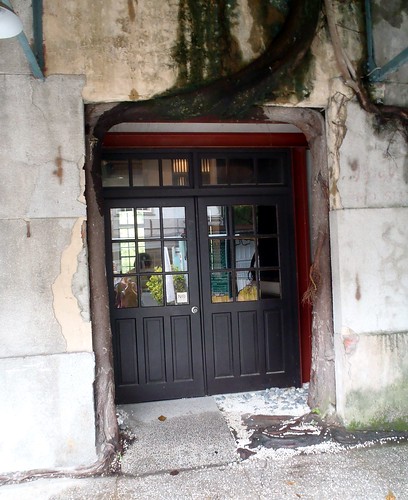
臺北華山藝文中心,一棵榕樹的根已經成為門框了。
Why you don't want banyans growing on your building. Take a careful look at this door, which I photographed on an old building in downtown Taipei. The roots have grown down from the roof and down the sides of the door. It looks nice, but the building will sooner or later be taken over by the banyan.
今天到華山藝文中心看原舞者演「迴夢」,高一生的故事。高一生是第一個接受現代教育的鄒族人,畢業于臺南師範學院,當老師、作曲家。他永遠夾扗部落與外界中間,他一生的課題是傳統與改變的衝突。
臺灣光復,高一生成為吳鳳鄉第一任鄉長。現在臺灣的政治教條將那個時代講的很簡單:『全都是蔣介石的錯,沒甚麼好討論的,所以不許討論。』
但其實,那個時代的動盪、紊亂,我們很難理解。因為蘇聯強盛,毛澤東征服大陸、北韓被金日成征服、胡志明扗越南來勢洶洶,導致美國人心惶惶,McCarthyism崛起,國務院推動的白色恐怖波及臺灣。
鄒人扗嘉義機場與國民黨軍隊打仗後退到山林。嘉義山中有人民公社,早上唱義勇軍進行曲、東方紅,升五星旗。雲林、嘉義山區共產黨遊擊隊橫行。
高一生努力為鄒人設想,于是提倡鄒族自治區的想法;說實扗的,這一招,太不識時勢!後來,因為有共產黨藏匿于阿里山,所以鄉長要負責。高一生被蓋上共產黨的標籤。
另外,好像有些公款問題;鄉長要用錢作鄒族教育款項,卻被密告貪污。鄒人不完全支持他,因為很多族人怪他當年鼓勵鄒族青年為日本人打仗,扗南洋陣亡眾多。
民國四十三年,高一生槍決于臺灣青島東路看守所。
今天我們在百餘公尺之遙的華山藝文中心看這齣戲,我想,高一生若有知,一定很安慰。
Today we went to a memorable performance by 原舞者 the Taiwan Indigenous Dance troupe, commemorating the life of the Tsou (Cou) intellectual Uyongu Yatauyungana 高一生(1908 – 1954). Uyongu was a man trapped in his time. Born in the Tsou tribe in the mountains of central
At the end of World War II, the ROC government made him magistrate of his township. The times around 1950 were confusing, and in
McCarthyism was rampant in the
Uyongu was doing his best for his people, and called for a Tsou Autonomous Region. This was not a politically wise call at a time the ROC was fighting for its life. Communist sympathizers were hiding in Tsou territory, and Uyongu was brought to account. There was some problem with public funds which Uyongu had, apparently, meant to be used for schooling, and he was charged with corruption. In addition, many of the Tsou did not forgive him for encouraging tribesmen to fight and die for
To make a long story short, Uyongu was executed in 1954 in a prison not ten minutes' walk from
The performance was brilliant. 高英傑 Gao Yingjie, Uyongu's second son played the part of Uyongu, and Uyongu’s granddaughter played the part of her aunt. (During today's performance, Uyongu's eldest son sat two rows in front of us.) Almost all the dialogue was in the Tsou language, with the Japanese language songs he composed, and some soliloquies in Mandarin. All but one of the twenty performers are Aborigines, from various tribes.
Of course, one singer stole the show:夏赫尤勞 Hiax Yulau, the 8 year old son of my good friend and neighbor Yulau Yukan. But it goes without saying that the Tayal of
The choreographer was the noted布拉瑞揚‧帕格勒法 Bulareyaung Pagarlava, from the Paiwan tribe; he has choreographed for such famous troupes as NYC's Martha Graham Dance Company. The main props used were bamboo poles and two bamboo ladders (Gao Yingjie informed me that all the bamboo came from Pnguu, where we spent so much time last year). The work was imaginative and moving. I couldn't help thinking that Uyongu would be comforted to see his son interpreting his life just around the corner from where that life ended.

今晚到中正堂國家音樂廳聽「柏林古樂學會樂團」演奏巴洛
This evening we went to the
The star of the show was Maurice Steger, one of the world's foremost recorder players. I have collected his CDs for some years, and wondered if maybe they have speeded up the recording? No, he actually does play that fast, and never misses a note.
Unfortunately, they had only the one performance in
臺灣有很多非常好的小劇團、樂團、舞團,可惜觀眾習慣看電視粗製爛造的俗氣節目,有心欣賞這些非主流的團體的人不多。這是大家的損失。
今年民國一百年。我們前幾天去看一個小劇團的戲,探討自身的心境、臺灣目前處境。演員認真演,演技純熟,佈景、服飾都得體。戲劇很好看;唯一讓我困惑的是,演抗戰後的臺灣,只演兩個項目:二二八與白色恐怖。臺灣六十年來的歷史只有這個可以演嗎?
人之常情,若經噩耗、心理受創傷,便會退縮、蟄伏、失去信心、不敢嘗試。臺灣奇蹟不是一個受過創傷的人民所能締造的。
民國六十年代,臺灣的氛圍是樂觀、堅強的;人民安居樂業、發奮圖強,沒有浩劫餘生的陰影。那時臺灣的氣息很積極,不是遍體鱗傷或心猶有餘悸的。六十年代,若與人談起二二八,他們通常說,這件事情已經過了,我們要向前看,要認真生活,不需要再被那些已經過去的事情束縛。
現代的哀怨、悲情,是八、九十年代政客為了爭權奪利刻意製造出來的情緒。臺灣原來很有朝氣、很長進,不會沒事怨天尤人。
更何況,二二八與白色恐怖到目前沒有一個中肯的結論;現在不容許客觀討論,因為這個問題牽涉到太多政治利益。但請想一想:「白色恐怖」根本不是中文;為甚麼?這與美國國務卿John Foster Dulles脫不了干係。但現在臺灣的「言論自由」不容許這種說法,因為一切的罪惡都要放到蔣中正的頭上。
現在與一般中、老年人談起民國四、五十年代的臺灣,多數人的回憶是美好的:臺灣很窮,處境危艱,生活很辛苦,但很平安、很充實。不信的話,自己去問問一些平凡老百姓他們五十年前的生活;看他們臉上顯出很祥和的神態,想到田裏巷尾、稻味草香、濃厚的人情味、治安好,雖然沒錢,可是大家一樣都沒錢,大家都打拼。大專聯考給每一個人一個平等的機會,只要努力念書,農家子女也可以念國立大學:學費低廉,也有公費。刻苦耐勞的成就感是甜美的。
依我的經驗,如果要概括六、七十年代臺灣的人民精神狀態,就是「打拼」兩個字。每一個人抱著希望,只要努力,就有好日子過。當時的精神,也可以用兩個當時常見的標語來說:「處變不驚」、「莊敬自強」。
不是否認政治問題,而是說,經歷過二二八的人不多,直接被「白色恐怖」波及的人很少;不是說他們沒有悲劇,而是說,他們的經驗不代表這六十六年來絕大多數臺灣人民的生活或經驗。
藝術要為政治服務呢?或者我們採取「民主」精神,以「民」為「主」,政府的存在,是為了服務國家而已;那麼藝術的地位遠遠的高于政治。只能政治為藝術服務,若藝術蘊藏政治企圖,就是出賣了藝術、出賣了民主。
如果劇團隸屬政黨,有固定意識型態,演戲只是為了政治目標,那這樣演有理。但是如果目標是如實敘述臺灣歷史,則失之偏頗。實在可惜,因為劇團其它方面都很用心,但寫到六十年來的臺灣,沒怎麼深入思考就落入俗套,照教條排戲。我相信,以他們的才華,劇本可以寫的更深入、更真實的!
www.flickr.com
|