Monday, July 27, 2009

Here's a delicious irony for you. We all know that the Internet is the information superhighway, increasing communication, closing distances, and allowing for open exchange of ideas and greater interaction between all of us on this big blue planet Earth doesn't that just make you warm all over and bring tears to your eyes?

Last week I noticed that the Search function on this blog, and any other Blogger blog, doesn't work. If you go to their HELP function, you may post your complaint so that they can ignore it. That's about the extent of what you can do. I have been trying in vain to email Blogspot or Google to ask about this question, but to date, I have been able to find no way to email either organization. Now (despondent drum roll, please), you can write snail-mail to Google at

1600 Amphitheatre Parkway
Mountain View, CA 94043
you can phone them at +1 650-253-0000, and you can fax them at +1 650-253-0001, but to the best of my ability, I have been able to find no way to email them directly.

How's that for communication, interaction, and open exchange of ideas? Now you’ll excuse me while I find a postage stamp.

Sunday, July 26, 2009

「你的耳朵很複雜。他們都是泰雅所以他們的耳朵不漂亮。我是布農族,你看我的耳朵多好看。我們布農的耳朵都很好看。你的耳朵很複雜,所以你可以去很遠的地方。」

A quick guide to Taiwan aborigines: Tayal and Bunun tribe: a not entirely unbiased presentation

"Your ears are complicated. All these people, they are all Tayal tribe, so their ears don't look good. I am Bunun tribe, so see how good my ears look? We Bunun all have good-looking ears. Your ears are complicated, so that means you can go to faraway places."

Wednesday, July 22, 2009

This morning we had a partial, almost total eclipse of the sun. That's natural, but what was shocking was the weather. Usually if there's an eclipse or meteor shower or comet, you can bet your booties that if it doesn't rain in Wulai, it's overcast. Not today. The weather was gloriously clear, perfect for viewing the sun getting chewed by the big dog in the sky.

I used a very high-tech device to view the eclipse: a pinprick in one piece of cardboard to project the sun’s image onto another piece of cardboard. It worked great.

The eclipse began around 8:45AM here, and lasted until around 11. The sunlight was noticeably weaker, so the morning wasn't so hot as it would have been. During a solar eclipse, tree leaves throw unusual shadows. You can understand why this sort of thing freaked out our ancestors.

Of course I couldn't let such an event go by without shooting dozens of nearly identical photos. For your edification, I have posted them on flickr: click here::

As I said, we got only a partial eclipse, although at the climax (height? acme? apogee? manatee? I forget the term), there was only a thin sliver of sun left. Across the straits, the lower reaches of the Yangtze River got the total eclipse. Good luck and smooth traveling to all the happy campers who trooped to Shanghai, Suchou, and Hangchou to view the great event; it rained all morning, all along the lower reaches of the Yangtze.

Tuesday, July 21, 2009

昨天是阿姆斯壯登陸月球四十周年。其後兩年,本野人來華。當時聽很多人說,中秋節已不熱鬧了;自從阿姆斯壯登錄月球卻沒看到嫦娥,更沒見到玉兔搗藥,地球上的人失去信心,對中秋節不感興趣。

I came to Taiwan two years after Armstrong landed on the moon. A lot of people told me that the all the fun had gone out of the Middle Autumn Moon Festival ever since Armstrong went up there and he didn't see Chang E in her palace, he didn't see the rabbit pounding medicine. They figured, if she's not up there, if the rabbit's not up there, there's not much fun in the Moon Festival.

說不定嫦娥、玉兔在,只是不同時空、不同次元,凡夫肉眼看不見而已。

管它的,中秋節照過不誤。自己心中想嫦娥、玉兔便可。賞月喝茶吃月餅就好了。

Monday, July 20, 2009

My mother was trained as an artist, but during World War II, she served her country by drafting battlefield maps ~~ in the Pentagon, as a matter of fact. In the Eyes Only drafting room, she had her own special desk separated from the rest by a curtain. Her maps could be seen only by the Joint Chiefs of Staff and President Roosevelt.

When I was in the 4th grade, for various reasons she decided she needed a job, and found one drafting for CalTech Geology. Many stories there, but the one I am telling today involves my parents' decision that we kids didn't need to be entertained, we should be able to entertain ourselves. As a result, to this day I have never lived in a house with a television.

All well and good, but one momentous July day in 1969 we wanted one. The Eagle was on the moon, and man's first step on the moon was going to be broadcast live.

It turned out we were not the only ones who just said NO to television. Many of the geologists who were first in line for the moon rocks also did not have televisions (smart people can find better things to do with their time than watch the idiot box?), so someone brought a set to the Moon Lab, and we went to watch it there.
(It may be hard for people today to understand what an overwhelming honor it was for these scientists to be first in line for the moon rocks. They earned that honor by decades of dedicated labor and groundbreaking discoveries. I recall that Eugene Shoemaker was there, as was Andy Ingersoll, who if I remember correctly was at the time one of the world's two or three astrogeologists.)

I vividly remember the excitement in the room as Armstrong stepped onto the surface of the Moon. Not the excitement that we beat the Russkies, or isn't that cool, or we're Number One, but the excitement of geologists seeing, live, rocks on another planet, and who knew they were the first geologists ever to see, live, rocks on another planet. Pure intellectual excitement and bliss.

Frankly, I don't think anybody in the Moon Lab but Mom and I were watching Armstrong. The geologists were straining to figure out, in the blurry black and white telecast, just what they were seeing. They knew they would be getting their share of the first rocks ever brought back from the Moon, but first they wanted an idea of what they would be getting, and what else there was to see.

Forty years ago today. In light of all the toil the United States devoted to that incredible, historical effort, it is comforting to know that NASA erased all the original tapes of the momentous Moon landing: :click here:::

and here::


Saturday, July 18, 2009

宋、孟元老著「東京夢華錄」(東京指宋古都開封,非日本東京)序:太平日久,人物繁阜,垂髫之童,但習皷舞,班白之老,不識干戈。

勢類今臺灣。

Thursday, July 16, 2009

Something funny we have noticed is that on the bus down from the mountains, generally the tourists, who may visit Wulai once in a decade or a lifetime, pay little attention to the spectacular scenery along the way; rather, it is Chao and I, who live here, who have our noses glued to the window and take in every view. The tourists who drive race along the road as if they were afraid of seeing something.

Chao has lived here for over a year now, I for over twelve years. I have been up and down that road thousands of times and never get enough of its beauty. Every day we feel very lucky to live in such a wonderful place.

I love living in the mountains. I can't imagine ever living in a city again, knock on wood.

However, before you sell your apartment and head to the high places, allow me to remind you that living in the mountains is not only about sitting comfortably drinking good tea. There’s a lot of work involved. Sometimes I joke that if I didn't do any yard work for two months, I wouldn't be able to find the house. Only it's not really a joke.

飲水思源. When you turn on the faucet, water comes out. Do you know where it comes from?

I can tell you exactly where my water comes from, and know every step of the way from the spring to my house. In Wulai, you find your own water. Ours (I share water towers with a neighbor, Mr Fu) comes from a spring a ways up the jungle.

Sounds nice, but it does have its inconvenience. From time to time, I come home all sweaty and dirty, step into the shower, turn on the faucet, and … and nothing. That means I have to go find where a pipe burst or fell apart or whatever. (Which explains how I got lost in the jungle one night: there's an earlier post::)
The other day Mr Fu told me that although we had some water coming in, we had trouble with our pipes, so yesterday morning we set out. We found the problem and decided that a section of pipe had to be replaced. Fortunately, Mr Fu had a length of pipe, but he injured his hand recently, so I had the honor of dragging it to our worksite. It's not particularly heavy, but doing something like that gives you an appreciation of drag.
But when you've done work like that, a victorious shower is especially sweet. You've earned your water.

To reach our house from the road, we have a flight of over a hundred steps up a ravine. During the strong winds last Friday, one of the trees with a light attached to it blew down, so I had to replace it. I am afraid of electricity, so I did not relish the prospect of those wires, but it had to be done. I selected another tree and a spot to attach the light to, climbed up, and put the light in place.


In the winter, the work would be enjoyable, but in the summer, don't even mention the heat and humidity: the mosquitoes eat you alive. I sprayed repellent all over myself until I repelled myself, but the mosquitoes managed to find every cell of skin that was not smothered in repellent.

Of course, over time you do develop some immunity to mosquito bites, but caterpillar poison is still very noxious. So you may not want to live in the mountains full time. But when you come, at least keep your eyes open and look at the view.

Monday, July 13, 2009

I've always thought so myself

Ditzy teen on cell: Why can't they, like, have two footballs instead so both teams could score?

Overheard by: Robert Gleyberman

Sunday, July 12, 2009

Another witless musing: somebody from Virginia is a Virginian, somebody from Georgia is a Georgian, somebody from Hawaii is a Hawaiian, somebody from New York is a crass loudmouth oops I mean a New Yorker, but what do you call somebody from Nevada? A Nevadan? Is there such a thing as an Illinoisian? An Ohioan? A Vermonter? A Massuchusetter? An Arizone? An Oregoner? My spell checker has some of these words, but I don't think anybody uses them.

Chicagoan, Los Angelean, Bostonian, San Franciscan. We name people from cities more than from states.

Don't ask me what it all means.

Saturday, July 11, 2009

不景氣,大家很辛苦。最近看到很多原本生意很好的店都關門大吉,原因是甚麼?房租太貴,賺的錢不夠付房租。房東寧可把店家趕走,把房子空在那兒養蚊子,也不肯降價。

是不是所有房東都惡劣?有沒有好房東?傳說中聽說過有很好的房東、很體恤房客困境的房東,但本野人未見過就是了。

每次看好好的店家被房東攆走,可惜。我的建議,所有租賃房屋應強制加入調解會(檢舉規避者,賞)。如果有糾紛,例如房東硬把房子收回,必須先經過調解會,決定妥善與否。調解會看店家實際生意的狀況,可勒令房東降房租。總該挽救一些創業生機。

Thursday, July 09, 2009

ciboq Yukal Kayu
「我到洛杉磯,他們都講英文,我一個字都聽不懂,怎麼辦?我跟他們講我們原住民的話,他們都不理我。怎麼辦?我想去找Indian講話看看。」
"I went to LA and they all speak English there. I couldn't understand a word, so what could I do? I used our tribe's aboriginal language to talk to them, and they just ignored me? What could I do? I wanted to find an Indian and see if I could talk to them."

Actually, in LA, I think they were speaking Spanish.

Wednesday, July 08, 2009

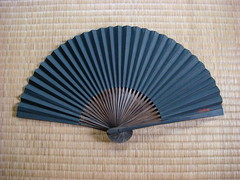
臺北小市民生活歷史綴筆,紙扇篇
我畢竟是北方體質,剛來華,悶熱難耐。幸虧摯友唐模看我的汗不是流的,是噴出來的。于是乎他介紹他老師鄭曼卿的克熱法寶:杭州黑扇。

問題是,時值民國六十年,對岸文化大革命正熾,解放軍誓言要血洗臺灣,所以大陸製品一律屬匪貨,不得進口、不得買賣,若查獲就麻煩。可是嘛~~重金之下有勇商,政府也睜一隻眼閉一隻眼。要買匪貨,若沒有牽涉到顛覆中華民國、殺蔣公、若有熟人、若知道門路,就不難買。

唐模帶我到衡陽路一家文具行,我們選了一把素面黑扇,順便請老闆幫我刻姓名,沒記錯的話,價錢五十元(刻字不算錢)。

從此,杭州黑扇成為我生活必需品,到夏天,寸不離身。

黑扇本作的比較精細;曲線流暢豐厚,靠邊骨間在紙層中崁三顆紙星=共產黨。


命根
Originally uploaded by Yugan Dali

後來線條較直,三星不見了。(星或許代表王星記,我不清楚。當時說代表共匪. Click here::)

原來黑扇都是素面的,沒畫畫題字。素面俐落,可是有畫有字也很有趣。有的鈔唐詩,可以邊納涼邊朗誦詩詞,雅致有餘。

現在買的黑扇,大不如以前。揮幾下,紙落骨斷。還好,仍有幾把舊的可以用。沒有舊的,毛筆店都有空白扇,任君揮毫塗抹,或請好友尊師題字留念。

我心裏有個希望,希望臺灣入夏,人手一把好扇,可驅熱省電,環保又減碳。

需要講嗎?我們不是楚留香,開扇要徐然展啟,不要甩開。揮扇,應培養清涼、瀟灑、幽雅的儀態:開扇,不急不庸。一把好扇難得,該珍惜。

更多


Taiwan is horribly muggy in the summer. I wouldn’t have survived so long if not for my good friend, Tam Gibbs, a student of tai-chi master Chen Manching. Tam introduced me to Hangchou Black Fans.

As the name implies, the fans come from mainland China. In the early 70s, the Cultural Revolution was raging, and the PLA was swearing they would wash Taiwan in blood. All products from the PRC were strictly forbidden, with severe punishment for importing or selling them… unless you really needed something, something innocuous that did not threaten the stability of the government or the lives of the people or officials. You could always find what you needed.

Tam took me to a stationery store near the train station and we bought me a fan. It cost about NT$50, in those days US$1.25. The boss carved my name on it, for free.

Ever since then, I have had a fan clutched in my hot little hand every summer. Some have broken, some have worn out, some have been lost, but give me a fan for a c0ol breeze and summer survival.

For more fans, please go to my flickr and take a look back and forth.

Monday, July 06, 2009

I understand that Alaska Governor Sarah Palin has resigned, and is looking around the internet for ideas about what to do in the future.
Hey, Candidate Palin, if you read this, the word you want is HERMITAGE. Find a nice isolated cave somewhere miles from the nearest microphone, computer, or telephone, and take a vow of silence.
祝:九十八年七月六日五點四三分一二秒。

Sunday, July 05, 2009

I have told before on this blog that the sibekay, 臺灣藍鵲 Taiwan Blue Magpie (Urocissa caerulea), was rare when I first moved to Wulai a dozen years ago, and visited our neighborhood only in the winter. Now they have become more common, and may be seen year round.

This morning my attention was attracted by a strange call. Apparently there was a juvenile sibekay in the tree out front, practicing its song, learning how to sing. I posted several clips on YouTube.


Another clip HERE:::

In the background of this clip :::CLICK::: you can hear cicadas and a byahoq 五色鳥 Muller's Barbet (Megalaima oorti).
http://www.youtube.com/watch?v=i6kV_QDCSA0

Another clip
HERE:::

In this clip, the sibekay has learned its song and sings like an adult. Hurrah!


This morning at one minute after 3AM is 09.07.05.03.01.

Stayed tuned to this blog for more vitally fascinating information!

Wednesday, July 01, 2009

Overheard on 高鐵 the Taiwan High Speed Rail
臺灣居然還有童工!

四歲小女生:「我今天休假,可是我明天還要上班。」

4 year old girl: "I've got a day off today, but tomorrow I have to go back to work."

Tuesday, June 30, 2009

語言不是理性的,是一種習慣,習慣成自然,就再也不去想它。可是偶而,把語言翻出來看一看,好玩。我們很多用語,用習慣了就不再思攷它了。

例如:出遠門要帶甚麼?當然帶行李。好了,為了遠行,這個「行」字很恰當,但「李」呢?

李不是一種水果嗎?出遠門多吃水果?或者現代人隨便說說?莫非「李」是它字的訓詁叚借?

行李一詞,其來久矣。左傳僖公三十年:
若舍鄭以為東道主,行李之往來,共其乏困,君亦無所害。
僖公三十年,西元前六三0年,可見斯詞歷史已有兩千六百多年。

說文,李,果也,从木子聲。段注
:古李理同音同用,故行李與行理竝見。

看樣子,行李當行理。這,有理吧。

眾所周知,李也是中國大姓。人口太多,難找出一個精确答案,可是中國最大的姓,大概是木子李。李姓總人口超過一億人,佔中國人的百分之八左右。

還好,因為自古有諺語說的好:李多人不怪。

Sunday, June 28, 2009

The Chief, Dali Watan, 我乾爸達利‧瓦旦 = 簡福源 = 山田樣, has been ailing for a couple years, with heart trouble mainly, but also problems with his red blood cells. He was admitted to the hospital a month ago, and spent two weeks in Intensive Care. Finally, they decided it was time to bring him home. He passed away late last night. His 78th birthday is Tuesday, the 30th.

We will miss him sorely.

It's hard to imagine what a different world Wulai was when he was a boy. The men of his father's generation were headhunters; Dali was of the first generation not to win a tattoo for his face by bringing home heads. Taiwan was occupied by Japanese warlords until he was in his early teens. The first airplane flew over Wulai when Dali was in grade school (click here:::). Once a week a supply truck came to the village, the only motor vehicle on the road, and there were no paved roads anywhere near Wulai. Because of the power station, a few of the Japanese offices had electricity, but nobody else. Some of the Tayal went to 新店 (Hsintien, on the outskirts of Taipei) once a year to buy things. What is now a half hour bus ride to Hsintien was a morning's hike; now crowded with high-rises, Hsintien was then a small farming village (no paved roads there, either). Wulai had a population of about 250, almost entirely Tayal aborigines, most of whom had never been out of the mountains.

Dali saw immense changes during his long, productive life. He excelled in school and got much more education than most people in Taiwan then, especially aborigines, so he was chosen as a leader. He served as Headman of Wulai Village, County Councilman, and Wulai Township Mayor, among other posts. (also: click here::)

Times were different when he took office, so he often had to use his fists to make his point with old headhunters and soldiers back from serving in the front lines of the Japanese Imperial Army during WWII. He was notorious for his hard work and exacting standards. He earned respect both within the tribe and beyond.

He was devoted to his tribe and his village, and worked for decades to help the Tayal and improve their lives. People remember him as a hard, principled, trustworthy man.

As for me, without Dali's help, I would not have the chance to live in Wulai.

Yaba, talakay sunun su Yugan ru Sabiy, ngihuy inlungan simu. Mhwaysu su balay. Amitabha.

Friday, June 26, 2009

It's not fair. Click :::here::: and click on the red square, and hold. Dodge the blue boxes without touching the border lines. Apparently Air Force fighter pilots can last for over two minutes.

I have played this off and on for months. Once I broke 13 seconds, but usually I get wiped out between 11 and 12 seconds. The other day I broke 12 seconds, and was so proud that I showed the site to Chao.

She tried it on her computer. Within a minute, I heard, "Oh, how nice, 14 seconds." 14 seconds?? A fluke, to be sure.

A few moments later, she asked me to look at her computer screen again: 14.587 seconds. Beginner's luck, it won't last.

Seconds later, she brightly announced, "Oh, that's nice, 15 seconds."

I asked her to turn off the game and do something serious, more befitting an adult.

Try it yourself and see. But please, if you break 12 seconds, just keep it to yourself, okay? I don't need to know about that.

Thursday, June 25, 2009

Long ago, I heard a story about a state dinner that took place in Washington DC some time before WWII. A politician found himself seated next to a Chinese guest. Trying to make conversation, when the soup was served the American pointed and asked, "Likee soopee?" The Chinese guest smiled and nodded. When the main course was served, the American pointed and asked, "Likee foodee?" The Chinese dinner partner beamed and nodded. And so on, course after course.

After dinner, the evening's speaker was presented: the Chinese guest. He rose and gave an eloquent speech in flawless English. When he was finished, he sat down, smiled to his American dinner partner, and asked, "Likee speechee?"